A vignette: Riding my bike home in the dark this evening, I saw something in the intersection ahead that I thought might be a flare from an earlier car accident. As I approached, the regular red flashing revealed it to be a bike taillight that had fallen off, now merely pleading not to be run over. I paused to scoop it up, and rode on while trying to figure out how to turn it off (there weren't many cars around, so my divided attention was not a huge problem). I went on examining it for a few blocks, and I could not figure out for the life of me how to turn the darn thing off -- it sort of felt like I had picked up stray baby bird, fallen from a nest, and it was still chirping for its mother despite my attempts to muffle it. When I came to U Street, I stopped to find the switch and put it in my bag. I was thinking about the futile craigslist lost-and-found posting I would make, as well as potential uses for my newfound light, when I noticed there was a guy without a taillight waiting at the stoplight. "Hey, you didn't just lose your blinkie, did you?," I asked. His head snapped back and forth from his seatpost to the flashing light in my hand. "Oh, yeah! Thanks, I really appreciate that." And that was that.
An upgrade: I put the puncture-resistant tire on my front wheel this morning, joining the month-old one on the back wheel. Hopefully I won't be needing to fix more flats anytime soon. In the spirit of Consumer Reports, I will report back here the first time I get one.
An estimation: I've had my Cross-Check for a bit more than a year now, and it didn't seem like I should have already worn out both tires. I've not kept track of my mileage in any way, but a rough estimation might be as follows. I've been in town for about 48 work weeks, and probably ride an average of 10 miles each work day. I've been in town for about 42 weekends, and probably ride an average of 15 miles per weekend day. That comes out to (48*5*10)+(42*2*15) = 3660 for a one year period. I guess a few thousand miles is okay for bike tires, which can't be as chunky as car tires.
Sunday, January 11, 2009

Wednesday, January 07, 2009
Flats
I've been getting a lot of flat tires on my bike. (I counted five patches on my current front inner tube when I fixed it last night.) They're almost always from shards of glass that embed themselves in my tire. I think the bike lanes actually increase the frequency with which this happens: When car windows or bottles are broken, the glass that falls in car travel lanes is quickly pulverized and pushed aside by the traffic. In the bike lane, this takes a long time to happen, and the cars push the glass into the bike lane.
This is, of course, a huge pain. But I am taking decisive action. When I last got a back flat (a few weeks ago), I bought a puncture-resistant tire made with a tough rubber compound and woven kevlar in the tread. Now that I've gotten a front flat, I'm going to get one for that wheel, too. The brand is Specialized Armadillo, and according to this promotional video, I should be in good shape:
This is, of course, a huge pain. But I am taking decisive action. When I last got a back flat (a few weeks ago), I bought a puncture-resistant tire made with a tough rubber compound and woven kevlar in the tread. Now that I've gotten a front flat, I'm going to get one for that wheel, too. The brand is Specialized Armadillo, and according to this promotional video, I should be in good shape:
Wednesday, December 31, 2008
Family portrait
Me and my housemates took a "family portrait:"
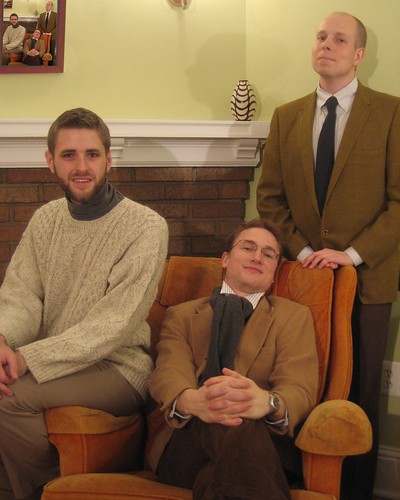
That's Steve on the left, Nils in the center. The picture will be hanging above our mantle once I get a print...
That's Steve on the left, Nils in the center. The picture will be hanging above our mantle once I get a print...
Tuesday, December 30, 2008
Sparkling
On the NY Times homepage, there's currently a headline that I read as "Sparkling Bacon of Japan's Future." It's actually "Sparkling Beacon of Japan's Future," but I think that if any culture on the planet has the wherewithal to devise bacon that sparkles, it would be the Japanese.
What the world needs now may be love, sweet love (and a big financial bailout), but sparkly bacon would help a lot.
What the world needs now may be love, sweet love (and a big financial bailout), but sparkly bacon would help a lot.
Sunday, December 28, 2008
Christmas weather
I had a good Christmas -- took the whole week off from work, so I was in Connecticut the whole time.
One good aspect of my holiday was that I got a dose of seasonal weather. Although the snow had already fallen when I got there, it was good and wintery for the first couple days. Davin (fresh from balmy Colombia) and I even had to push the car up the driveway while Dad whirred the tires.
I was particularly thrilled to do some sledding. My parents live on Fire Tower Road, so named because it leads to what was once the site of a fire tower at the top of the (small) mountain. The neighbors 3/4 of a mile up the hill had plowed, but not salted or sanded, so the surface of the road was packed snow and ice. Davin and I took several runs, walking up to the top and sledding down. Here we are before heading down:

I arrived in DC this afternoon to temperatures in the upper 60s. It was nice -- I took a bike ride -- but sort of disorienting.
One good aspect of my holiday was that I got a dose of seasonal weather. Although the snow had already fallen when I got there, it was good and wintery for the first couple days. Davin (fresh from balmy Colombia) and I even had to push the car up the driveway while Dad whirred the tires.
I was particularly thrilled to do some sledding. My parents live on Fire Tower Road, so named because it leads to what was once the site of a fire tower at the top of the (small) mountain. The neighbors 3/4 of a mile up the hill had plowed, but not salted or sanded, so the surface of the road was packed snow and ice. Davin and I took several runs, walking up to the top and sledding down. Here we are before heading down:

I arrived in DC this afternoon to temperatures in the upper 60s. It was nice -- I took a bike ride -- but sort of disorienting.
Saturday, December 20, 2008
Childhood misconceptions
In the short documentary that's part of the Michel Gondry music video collection, he says that when he was a child, he lived on the edge of a city, and always wondered if the earth was a solid ball of city with a splotch of countryside on it, or a solid ball of city with a splotch of city on it. This is one of the more whimsical childhood misconceptions I've heard, but I think everyone had at least a couple.
My dad said, for example, that when he was a kid growing up in Hartford, he was always confused why the state of Connecticut was sometimes shown with its little appendage on the bottom left, and sometimes with it on the top right. The version with it on the top right, he later realized, was the United States.
Likewise, for me, in the apartment building where my grandparents lived, there was a set of emergency lights mounted on the wall next to the door of the neighboring apartment. One time I asked what they were for, and the response got scrambled enough in my young brain that for quite some time after that I was under the impression that there were emergency personnel (EMTs, firefighters, etc.) who waited in that apartment until they were needed to respond to incidents.
I would enjoy hearing about any other childhood misconceptions in the comments, if you're willing to share.
My dad said, for example, that when he was a kid growing up in Hartford, he was always confused why the state of Connecticut was sometimes shown with its little appendage on the bottom left, and sometimes with it on the top right. The version with it on the top right, he later realized, was the United States.
Likewise, for me, in the apartment building where my grandparents lived, there was a set of emergency lights mounted on the wall next to the door of the neighboring apartment. One time I asked what they were for, and the response got scrambled enough in my young brain that for quite some time after that I was under the impression that there were emergency personnel (EMTs, firefighters, etc.) who waited in that apartment until they were needed to respond to incidents.
I would enjoy hearing about any other childhood misconceptions in the comments, if you're willing to share.
Thursday, December 18, 2008
Mobility
In a chain of email messages to me and my brother about coming to town for Christmas, my mother warned us that snow is expected. We both responded that we were looking forward to the snow, but Mom cautioned:
"...this could complicate our mobility significantly."
Heh. It sort of sounds like she's issuing a government report on future snow challenges.
"...this could complicate our mobility significantly."
Heh. It sort of sounds like she's issuing a government report on future snow challenges.
Monday, December 15, 2008
Initials
Slightly whiny/ranting post:
The Post has an article on trade associations feeling the pinch of the recession. It happens to mention two different organizations that have formally changed their names to their initials:
Okay, so they want to make their names seem more modern, and maybe signal a broader mission than their original names conveyed. But please, just change your friggin' name. Officially changing it to the initials of your former name may seem like a nice compromise -- everyone can keep referring to you by the same acronym they've always used, but the antiquated/narrow name is dropped. Seems sensible enough, but it sounds asinine outside a board meeting.
This trend may stem from KFC, nee Kentucky Fried Chicken. They made a successful transition to non-acronym acronym because everyone knows what they do. They serve fast food, much of which is fried chicken, but they were able to get rid of the word "fried" in their name when it became undesirable, and excise the slightly outdated-seeming "Kentucky," to boot. This does not work, however, if many people don't know what you do. Every time the New York Times prints a health article that references something in BMJ, the poor reporter is forced to say that it was formerly called the British Medical Journal. Even though the name was changed in 1988, they have to keep saying it because otherwise no one outside the field would know what kind of organization BMJ is. When people from these trade organizations introduce themselves to members of Congress, do they say they're from "AeA, the organization formerly known as the American Electronics Association"?
If these groups can't bring themselves to part with their initials, a much better option is to change the words to fit. For instance, the U.S. General Accounting Office became the Government Accountability Office in order to reflect a broader mission. It may take some people a while to realize the underlying name has changed, but at least you're not left having to explain what the initials stood for before you officially declared that they no longer do.
(I realize that I've given this more airtime than it deserves, but it's a pet peeve.)
The Post has an article on trade associations feeling the pinch of the recession. It happens to mention two different organizations that have formally changed their names to their initials:
- "...ASAE, formerly known as the American Society of Association Executives..."
- "...AeA (formerly the American Electronics Association)..."
Okay, so they want to make their names seem more modern, and maybe signal a broader mission than their original names conveyed. But please, just change your friggin' name. Officially changing it to the initials of your former name may seem like a nice compromise -- everyone can keep referring to you by the same acronym they've always used, but the antiquated/narrow name is dropped. Seems sensible enough, but it sounds asinine outside a board meeting.
This trend may stem from KFC, nee Kentucky Fried Chicken. They made a successful transition to non-acronym acronym because everyone knows what they do. They serve fast food, much of which is fried chicken, but they were able to get rid of the word "fried" in their name when it became undesirable, and excise the slightly outdated-seeming "Kentucky," to boot. This does not work, however, if many people don't know what you do. Every time the New York Times prints a health article that references something in BMJ, the poor reporter is forced to say that it was formerly called the British Medical Journal. Even though the name was changed in 1988, they have to keep saying it because otherwise no one outside the field would know what kind of organization BMJ is. When people from these trade organizations introduce themselves to members of Congress, do they say they're from "AeA, the organization formerly known as the American Electronics Association"?
If these groups can't bring themselves to part with their initials, a much better option is to change the words to fit. For instance, the U.S. General Accounting Office became the Government Accountability Office in order to reflect a broader mission. It may take some people a while to realize the underlying name has changed, but at least you're not left having to explain what the initials stood for before you officially declared that they no longer do.
(I realize that I've given this more airtime than it deserves, but it's a pet peeve.)
Wednesday, December 10, 2008

Wednesday, December 03, 2008
Education costs
The most-emailed article on the New York Times website right now is about the inexorable growth of college costs over the last couple decades. (It was at college, incidentally, that I learned to use the word "inexorable.") The news peg is a new study that compares increases in higher education costs to increases in family income; the study also makes useful calculations of "net college costs," which factor in financial aid grants.
I could quote the numbers, but you know...it's really expensive. What are we getting for these increased costs? At the high end, which includes my education at Carleton, there are big building projects, substantial investments in technology, lowering the faculty to student ratio, and probably many other things that I'm unaware of. Most of which are very worthwhile. But I would submit that at least a portion of these increasing costs are driven by the competition surrounding U.S. News and World Report-style rankings. Criticizing these rankings is pretty much cliche by now, but I suspect they really do drive a focus in college administrations (mostly unconscious, probably) on the trappings of high quality education as measured by those indexes, as opposed to the intangibles that really make a high quality education. (Plus, if all your peer institutions are charging a lot more, low tuition almost seems to cast doubt on your own school's prestige.)
Another factor: There has been very little downward pressure on college costs. As the article mentions, middle class families generally decide that college is extremely important, and that they will finance it with debt if needed. While I appreciate all those subsidized federal loans, one of their main effects is probably to increase colleges' pricing power. If people didn't have access to all that cheap financing, schools would be under more pressure to keep costs in check because otherwise their students wouldn't be able to pay.
Not that I know what to do about this, since insisting on more efficient spending is easier said than done. I guess the increases in cost wouldn't be much of a problem if admissions were need-blind and institutions met 100% of need with grants. That would take a whole lot of money, but I know I'd give more generously to Carleton if it were toward that explicit goal.
I could quote the numbers, but you know...it's really expensive. What are we getting for these increased costs? At the high end, which includes my education at Carleton, there are big building projects, substantial investments in technology, lowering the faculty to student ratio, and probably many other things that I'm unaware of. Most of which are very worthwhile. But I would submit that at least a portion of these increasing costs are driven by the competition surrounding U.S. News and World Report-style rankings. Criticizing these rankings is pretty much cliche by now, but I suspect they really do drive a focus in college administrations (mostly unconscious, probably) on the trappings of high quality education as measured by those indexes, as opposed to the intangibles that really make a high quality education. (Plus, if all your peer institutions are charging a lot more, low tuition almost seems to cast doubt on your own school's prestige.)
Another factor: There has been very little downward pressure on college costs. As the article mentions, middle class families generally decide that college is extremely important, and that they will finance it with debt if needed. While I appreciate all those subsidized federal loans, one of their main effects is probably to increase colleges' pricing power. If people didn't have access to all that cheap financing, schools would be under more pressure to keep costs in check because otherwise their students wouldn't be able to pay.
Not that I know what to do about this, since insisting on more efficient spending is easier said than done. I guess the increases in cost wouldn't be much of a problem if admissions were need-blind and institutions met 100% of need with grants. That would take a whole lot of money, but I know I'd give more generously to Carleton if it were toward that explicit goal.
Subscribe to:
Posts (Atom)
